
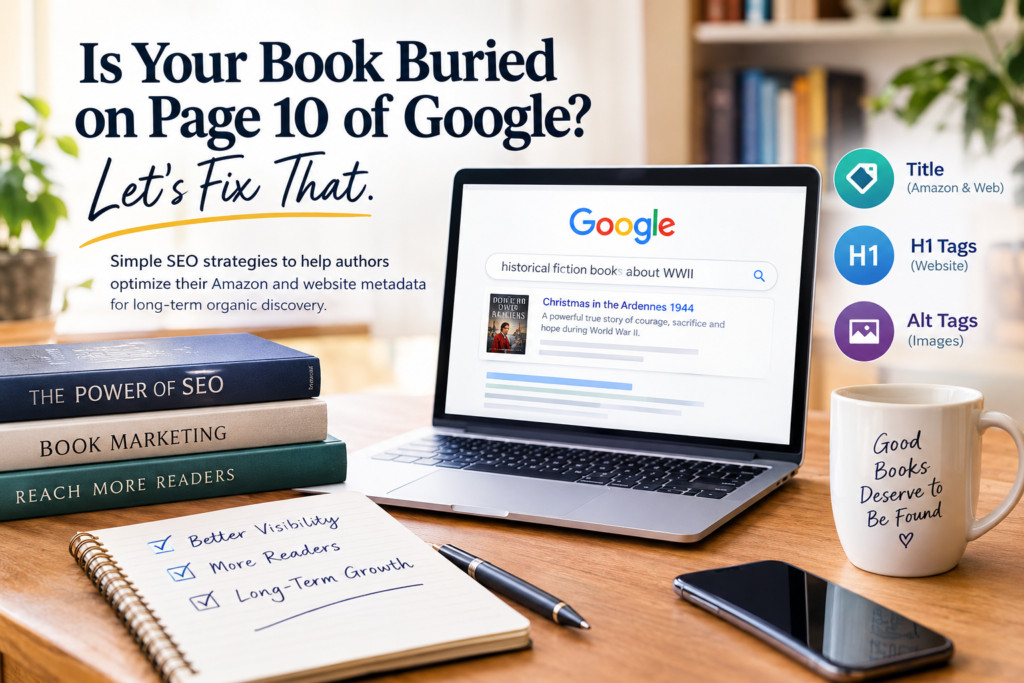
Is Your Book Buried on Page 10 of Google? Let’s Fix That.
You wrote the book. You published it. You even have a beautiful Amazon listing and a website..
But there’s one problem:
Readers still can’t find you.
If your book only appears when someone searches your exact title or author name, you may be missing thousands of potential readers who are searching for the kind of book you wrote rather than your name.
That’s where author SEO comes in.
SEO isn’t just for large businesses and bloggers. Authors can use search optimization to help their books, websites, articles, and author profiles become easier to discover over time.
And the good news?
You don’t necessarily need to publish more content.
Sometimes, you need to optimize what you already have.
1. Start With What Readers Actually Search For
One of the biggest SEO mistakes authors make is optimizing everything around the book title.
Your title is important, but it may not be what your potential reader searches for.
For example, a reader may search:
-
historical fiction about World War II
-
cozy mystery set in a small town
-
books about overcoming anxiety
-
Christian books for women
-
fantasy books with elves and magic
-
leadership books for higher education
-
children’s books about friendship
These are reader-intent searches.
Your goal is to understand the language your ideal readers already use and connect that language to your book.
Instead of asking:
“What keywords describe my book?”
Ask:
“What would my ideal reader type into Google or Amazon when looking for a book like mine?”
That small change in thinking can completely change your SEO strategy.
2. Optimize Your Book Metadata
Your Amazon book page contains information that helps Amazon understand what your book is about.
Your title, subtitle, description, categories, and keywords all contribute to how your book is positioned.
Your title and subtitle should clearly communicate what the reader is getting.
For example, a nonfiction title might be creative, but if the subtitle clearly explains the subject, audience, or benefit, it gives both readers and search systems more context.
Think of metadata as signposts.
The clearer your signposts are, the easier it is for the right reader to understand where your book belongs.
But don’t stuff keywords.
Repeating the same phrase over and over can make your copy sound unnatural.
Good SEO should still sound like something a human would want to read.
3. Your Website Needs an SEO Structure Too
Your author website shouldn’t simply look attractive.
It should also help search engines understand each page.
One of the most important elements is your H1 heading.
Your H1 is essentially the main heading of a webpage.
Instead of having a vague heading such as:
“Welcome to My Website”
you could use something more descriptive and relevant to the page.
For example:
Historical Fiction Author Writing World War II Stories
This immediately tells visitors and search engines what the page is about.
Each important page should have a clear primary topic.
Your book pages, author bio, blog posts, and resource pages can each target different but related search intent.
4. Don’t Ignore Image Alt Tags
Authors often spend considerable time creating book covers, promotional graphics, event photographs, and website images.
But those images can also provide useful context.
That’s where alt text comes in.
Instead of an image being labelled something meaningless like:
IMG_4837.jpg
the alt text could describe the image naturally.
For example:
“Christmas in the Ardennes 1944 book cover”
Alt text is primarily an accessibility feature, so it should accurately describe the image rather than become a place to stuff keywords.
Think:
Describe first. Optimize naturally second.
5. Create Individual Pages for Important Books
If you have several books, don’t put everything onto one generic “Books” page and expect Google to understand every title equally.
Consider creating a dedicated page for each important book.
A strong book landing page can include:
Book title
Clear H1
Book description
Who the book is for
Relevant themes or topics
Author information
Reviews or endorsements
Frequently asked questions
Links to purchase
This gives search engines substantially more context about the individual book.
It also gives readers a better experience.
6. Match SEO to Search Intent
Not every search means the same thing.
Someone searching:
“what is historical fiction?”
has informational intent.
Someone searching:
“best historical fiction books about WWII”
is researching options.
Someone searching:
“buy Christmas in the Ardennes 1944”
has much stronger purchase intent.
Your content should reflect the reason behind the search.
This is why author SEO isn’t simply about ranking for keywords.
It’s about connecting the right content with the right reader at the right stage of discovery.
7. Google Ranking Takes Time
Here’s something every author should understand:
SEO is not a magic switch.
You can optimize a page today and not see meaningful movement tomorrow.
Organic search discovery can take time because search engines evaluate many factors, including relevance, content quality, authority, links, user experience, and competition.
That’s actually one of the advantages of doing SEO properly.
A paid advertisement can stop producing traffic when the budget stops.
A well-optimized page can continue attracting organic visitors long after you publish it.
That’s why I look at SEO as a long-term discoverability asset, rather than a quick promotional trick.
8. Amazon SEO and Google SEO Are Not Exactly the Same
This distinction is important.
Amazon is primarily a marketplace.
Google is a broader search engine.
The way readers search on each platform can be different.
Someone on Amazon may be ready to browse or purchase a book.
Someone on Google may be researching a topic, looking for recommendations, searching for an author, or trying to solve a problem.
So your strategy shouldn’t simply be:
“Put the same keywords everywhere.”
Instead, think about the platform, the reader, and the intent behind the search.
A Simple Author SEO Checklist
Before you publish your next book page or website update, ask:
Amazon
☐ Is the book title clear?
☐ Does the subtitle communicate the book’s subject or reader benefit where appropriate?
☐ Are the categories relevant?
☐ Are the backend keywords aligned with genuine reader searches?
☐ Does the description naturally communicate important search concepts?
Website
☐ Does every important page have a clear H1?
☐ Does the page title accurately describe the page?
☐ Does the content address a specific reader need or search intent?
☐ Are images given accurate, descriptive alt text?
☐ Does each major book have its own dedicated landing page?
☐ Are relevant internal links connecting your books, blog posts, and author pages?
Long-term discovery
☐ Are you publishing useful content around topics your readers search for?
☐ Are you monitoring which searches and pages bring visitors?
☐ Are you updating weak or outdated pages?
☐ Are you giving SEO enough time to work?
The Goal Isn’t to Be Everywhere
You don’t need your book to rank #1 for every possible keyword.
You need to become more visible for the searches that matter to your readers.
That’s the difference between chasing rankings and building discoverability.
Your book may already contain the information people are searching for.
The opportunity may simply be to structure and present that information in a way that both readers and search engines can understand.
And that is where a thoughtful author SEO strategy can make a difference.
Want the checklist?
I’m putting together my 2026 Author SEO Optimization Checklist to help authors review their Amazon listings and website pages for stronger organic discoverability.
Comment “SEO” below and I’ll send it to you via DM.